

De Quervain’s Tenosynovitis – Symptoms & Treatment
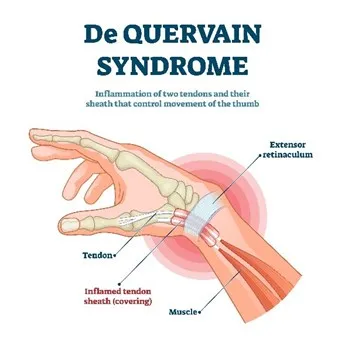
What is De Quervain’s Tenosynovitis
De Quervain’s tenosynovitis is swelling of the tendons that run along the thumb side of the wrist and attach to the base of the thumb. This occurs when the tendons are constricted by the sheath that they run through to get from the wrist to the hand.
This condition can cause pain and tenderness along the thumb side of the wrist. This is particularly noticeable when you are:
- Moving the thumb
- Forming a fist
- Grasping or gripping something
- Turning the wrist
- Lifting something with your arms in front of you and thumbs pointed toward the ceiling (e.g., lifting a child)
These are signs of De Quervain’s tenosynovitis:
- You may feel pain over the thumb side of the wrist. This is the main symptom. The pain may appear either gradually or suddenly. It starts in the wrist and can travel up the forearm. The pain is usually worse when the hand and thumb are in use. This is especially true when forcefully grasping and/or lifting objects or twisting the wrist.
- You may see swelling over the thumb side of the wrist. This swelling may accompany a fluid-filled cyst in this region.
- You may feel a catching or snapping sensation when moving the thumb.
- Pain and swelling may make it difficult to move your thumb and wrist.
What are the treatments for De Quervain’s Tenosynovitis?
De Quervain’s tendinosis is treated by reducing the swelling/irritation of the tendons and tendon sheath, thereby relieving the pain caused by the condition.
Nonsurgical Treatment
- Physiotherapy. Consultation and treatment by Physiotherapist is essential in the management of the condition to help alleviate pain, swelling and help improve function of the involved hand. The Physiotherapist will help with conservative management and prescribe appropriate exercises, recommend splint and also help advice you about activity modification
- Splints. A removable splint that keeps the wrist straight and the thumb still in a comfortable position may improve pain, especially when worn at night.
- Non-steroidal anti-inflammatory drugs (NSAIDs). Anti-inflammatory medication can be taken by mouth or applied topically to reduce pain and inflammation in the tendon.
- Activity modification. Avoiding activities that cause pain and swelling may allow the symptoms to go away on their own.
- Corticosteroids. An injection of corticosteroids into the tendon sheath can be effective in addressing the condition by reducing swelling and relieving pain. One or 2 injections have been shown to relieve the condition in 50 to 80% of patients.
Surgical Treatment
Surgery may be recommended if symptoms are severe or do not improve with non-operative management. The goal of surgery is to release the tendon sheath to make more room for irritated tendons. When done correctly, this can relieve the symptoms of De Quervain’s tenosynovitis without affecting hand/wrist function.
During surgery:
- The surgeon first identifies and protects the nerves that live near the tendon sheath.
- The surgeon then releases the sheath in a way that avoids tendon instability.
- If there is excess tissue (tenosynovium) around the tendons, the surgeon will remove it.
- The incision is then closed, and a bandage (and sometimes a splint) is applied.
Regardless of the treatment, you can usually resume normal use of the hand once comfort and strength have returned. Your orthopedic surgeon can advise you on the best treatment for your situation.
CONTACT Monarch Physiotherapy Clinic for more details on treating De Quervain’s Tenosynovitis.