

Achilles Tendinitis
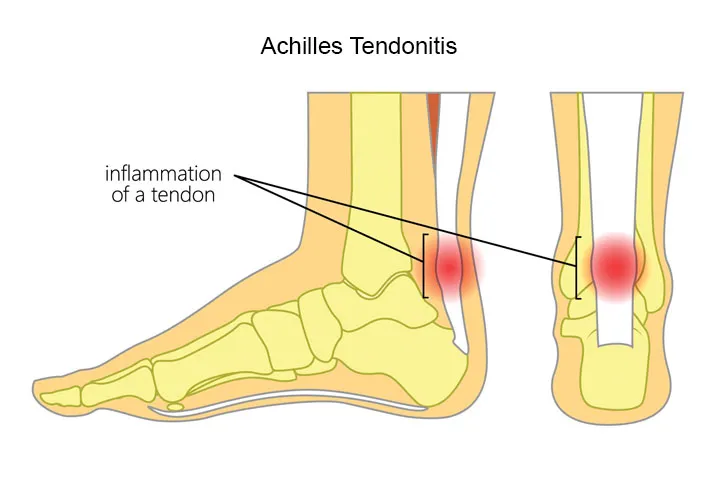
What is Achilles tendinitis?
Achilles tendinitis is when there’s irritation and inflammation in the Achilles tendon, a large tendon that attaches your calf muscles to your heel bone or calcaneus.
You use the muscle to jump, walk, run, and stand on the balls of your feet. Overusing or damaging this area can lead to inflammation and pain.
There are two types of Achilles tendinitis:
- Non-insertional involves small tears in the fibers of the middle portion of your tendon and tends to affect younger adults who are active.
- Insertional affects the lower portion of your tendon, which attaches to your heel bone. It can affect people of any age, including individuals who aren’t physically active.
Simple home treatments can help relieve pain and heal your condition.
However, if home treatment doesn’t work, it’s important to contact a healthcare professional. If your condition gets worse, your tendon can rupture, or burst. You may need medication or surgery to treat the condition.
Symptoms of Achilles tendinitis
The main symptom of Achilles tendinitis is pain and swelling in the backside of your heel when you walk or run. You may also have tight calf muscles and a limited range of motion when you flex your foot.
Common symptoms of Achilles tendinitis also include:
- pain in your heel or behind your calf when you touch or move it
- pain or swelling in that area that worsens when you’re walking or running, or the day after you exercise
- discomfort or swelling in the back of your heel
- limited range of motion when flexing your foot
- stiffness and soreness in the Achilles tendon when you wake up
- warmth around the heel or along the tendon
- difficulty standing on your toes
- thickening of the Achilles tendon
Some of all of these symptoms may point to Achilles tendinitis and you should see a doctor as soon as possible.
Treating Achilles Tendinitis
Many treatments are available for AT, ranging from home remedies like rest and anti-inflammatory medication to more invasive treatments like steroid injections, platelet-rich plasma (PRP) injections, and surgery.
Here are some other common treatments for Achilles tendinitis:
- reducing your physical activity
- switching to low-impact exercises, such as swimming
- very gently stretching and later strengthening your calf muscles
- icing the area after exercise or when in pain
- elevating your foot to decrease any swelling
- wearing a brace or walking boot to prevent heel movement
- going to physical therapy
- taking anti-inflammatory medication, such as aspirin (Bufferin) or ibuprofen (Advil), for pain relief
- wearing a shoe with a built-up heel to take tension off your Achilles tendon
Make sure you talk to your doctor about Achilles tendinitis rather than taking all the measures yourself.
RICE Method
The rest, ice, compression, and elevation (RICE) method can be effective in treating Achilles tendinitis right after you’re injured. Here’s how it works:
- Rest. Don’t put pressure or weight on your Achilles for 1 to 2 days until you can walk without pain. The tendon usually heals faster if no additional strain is placed on it during this time. Your doctor may suggest that you use crutches if you need to get around while you have Achilles tendinitis.
- Ice. Put ice in a bag, wrap the bag in a cloth, and place it against your skin. Hold the bag on your tendon for up to 20 minutes, then take the bag off to let the tendon warm up again. The ice usually makes inflammation or swelling go down faster.
- Compression. Wrap a bandage or athletic tape around your tendon to compress the injury. You can also tie an article of clothing around this area. This helps prevent additional swelling. Make sure not to wrap or tie anything too tightly around your tendon, as it can limit blood flow.
- Elevation. Elevate your foot above the level of your chest. Because your foot is higher than your heart, blood returns to the heart and keeps the swelling down. This is easiest to do by lying down and putting your foot on a pillow or other raised surface.
Your Next Steps…
Request An Appointment
Receive A Custom Treatment Plan
Work Hard and Progress In Your Recovery
Recover & Enjoy Life Pain-Free!